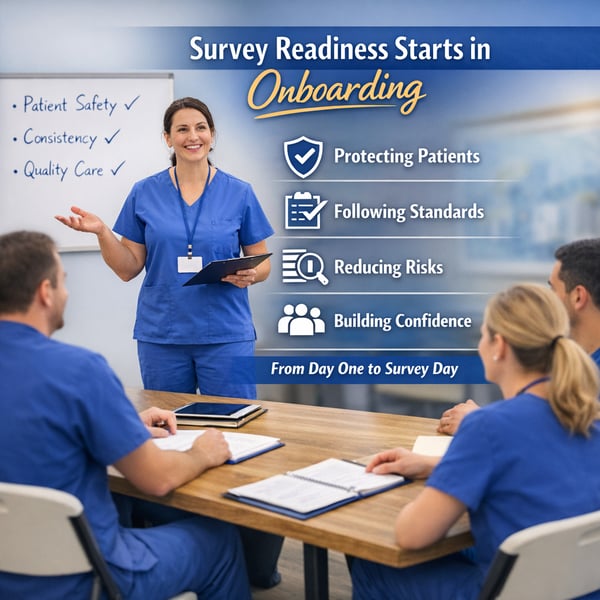
Is Your Onboarding Creating Survey-Ready Employees?
This article explains how to design onboarding so that survey preparedness becomes a natural outcome of doing the right things for patient safety.
Stay up-to-date on all of our industry content.
4 min. read
Accreditation surveys are not standalone events. They are a structured way to confirm that your organization consistently delivers safe, high-quality care using processes that reduce risk and protect patients.
If survey readiness only enters the conversation weeks before a survey, new employees are already at a disadvantage. True readiness is built during onboarding through intentional education, clear expectations, and consistent reinforcement.
This article explains how to design onboarding so that survey preparedness becomes a natural outcome of doing the right things, the same safe way, every day.
Start with the Purpose: Higher Standards and Safer Care
Survey readiness should never be framed as a regulatory obligation alone. Accreditation exists to ensure patients receive care that is safe, consistent, and aligned with nationally recognized best practices.
During onboarding, help new employees understand that surveys are designed to:
Promote adherence to higher standards of patient care
Reduce variation in clinical and operational practices
Identify risks before they result in patient harm
Reinforce systems that support safety, quality, and accountability
Validate that policies are not just written, but followed consistently
Survey preparedness is not about performing well for a surveyor. It is about building reliable habits that keep patients safe.
Normalize Survey Readiness as Everyday Patient Safety
One of the most effective onboarding strategies is removing the idea that surveys are rare, high-pressure events. When teams treat survey readiness as “special,” they unintentionally teach new employees that safety practices are conditional.
Set expectations early by reinforcing that:
Surveys assess routine workflows and routine safety behaviors
Compliance is part of daily responsibilities because it reduces patient risk
Readiness is continuous, not seasonal, because patient safety is continuous
Every role contributes to safety outcomes, not just clinical roles
This mindset helps new employees connect their daily work to the larger safety system of the organization.
Teach What Surveyors Actually Do and Why They Ask
Uncertainty creates anxiety. Onboarding should demystify the survey process before employees ever encounter a surveyor.
Prepare new employees by explaining that surveyors typically:
Observe care delivery and operational flow to assess safety reliability
Ask staff to describe how they do their work to understand real practice
Review documentation and records to confirm safe continuity of care
Look for alignment between practice and policy because inconsistency creates risk
Focus on systems and patterns more than individual performance
When employees understand the intent behind the questions, they can respond calmly and recognize that the goal is safer care, not “catching mistakes.”
Build Role-Specific Survey Confidence Through Safety-Critical Habits
Survey readiness is most effective when it is personalized. It also becomes more meaningful when it is anchored to what protects patients in that specific role.
Onboarding should include role-specific education that helps employees understand:
Which safety-critical standards apply to their position
What surveyors may ask and what those questions are assessing
How policies connect to patient safety outcomes, not just documentation
Where to find resources quickly when uncertainty could create risk
How to escalate concerns early to prevent harm
This clarity prevents guessing and reinforces that reliable habits exist to protect patients.
Coach Employees on How to Answer Survey Questions with Safety in Mind
Knowing how to answer is just as important as knowing what to do. New employees should learn a consistent approach that prioritizes honesty, clarity, and patient safety.
During onboarding, provide guidance such as:
Answer honestly based on your own work and your actual workflow
Describe what you do to keep patients safe, step by step
Ask for clarification if a question is unclear, because clarity prevents errors
Take a moment to think, especially when discussing safety processes
Say “I don’t know, but I can find out” and then follow through
This approach protects patients and reduces the pressure to improvise or guess.
Reinforce Staying Within One’s Role to Reduce Risk
A common survey risk is well-intentioned overexplaining or speculating. That can lead to inconsistent statements and can also expose gaps in how new employees understand safe practice.
Onboarding should reinforce that employees should:
Speak only to their own responsibilities and their own routine process
Avoid speculating about steps they do not perform
Redirect questions outside their scope to the appropriate person
Focus on how their work aligns with policy, because reliability reduces risk
This guidance does more than support survey performance. It reinforces safe boundaries and clear accountability.
Address Common Survey Pitfalls by Tying Them to Patient Safety
Proactive onboarding can prevent common mistakes that often surface during surveys. The key is explaining why these mistakes matter.
Educate new employees to avoid:
Guessing answers, which can hide safety gaps that should be corrected
Using phrases like “we usually” or “we’re supposed to,” which signals variation
Contradicting documented policies due to unfamiliarity, which increases risk
Appearing defensive, which can prevent learning and improvement
Volunteering unnecessary information, which can confuse the safety narrative
Frame these pitfalls as signals of inconsistency. Inconsistency is where safety risk grows.
Make Survey Readiness a Continuous Onboarding Theme
The most effective onboarding programs do not treat survey readiness as a single conversation. They build it through repetition, reinforcement, and practice, the same way they build any high-reliability behavior.
Reinforce readiness through:
Ongoing exposure to policies that drive safe, consistent practice
Scenario-based training that emphasizes safety decisions and escalation
Mock survey questions that focus on how employees keep patients safe
Coaching that strengthens “speak up” culture and reduces workaround behavior
Leadership modeling calm, consistent behaviors that prioritize patient safety
Use Simple Language That Connects Standards to Outcomes
New employees adopt what they understand. If policies are presented as compliance documents, employees will treat them like paperwork. If policies are presented as safety tools, employees will use them.
When onboarding, teach staff to translate standards into outcome language, such as:
“This process prevents medication errors.”
“This checklist protects the patient when timing matters.”
“This documentation ensures continuity of care.”
“This step reduces infection risk.”
When employees can explain the purpose in plain language, they are more likely to follow the process consistently and describe it clearly during a survey.
When Onboarding Is Safety-Centered, Surveys Follow Naturally
Survey-ready employees are not created in the weeks before a survey. They are created through onboarding that prioritizes clarity, confidence, and a shared commitment to safe care.
When employees understand the purpose of surveys, know what to expect, and feel equipped to answer honestly within their role, survey readiness becomes a byproduct of reliable patient safety practices.
The question is no longer whether employees are ready for surveys. It becomes whether onboarding is building consistent habits that keep patients safe.