

Operations
Governance Technology Should Reduce Risk - Not Just Manage It
The best governance systems do not create more work. They quietly remove risk from everyday operations.
Credentialing and privileging timelines exist to ensure that organizations operate with clarity and confidence when making decisions about patient safety.
4 min. read
Credentialing and privileging are the clearest expressions of a governing body’s accountability for patient safety and clinical quality.
Strong healthcare organizations are intentional about who is allowed to care for patients within their walls. They understand that credentialing and privileging are not administrative hurdles to clear, but deliberate acts of governance.
At its best, this process reflects discipline, accountability, and respect for patient safety. It signals that the governing body knows who is providing care, why they are qualified to do so, and that this approval is based on current, verified information.
When credentialing and privileging are reduced to a checkbox, that intent is lost. Timelines become flexible. Documentation becomes stale. Governing body approval becomes procedural rather than purposeful.
The difference matters.
Credentialing and privileging timelines exist to ensure that decisions about patient care are made with accuracy, recency, and oversight. When those timelines are followed, organizations operate with clarity and confidence.
When they are not, risk quietly accumulates long before a surveyor ever arrives.
At the facility level, providers are credentialed and privileged on behalf of the governing body. This is not a delegated or passive process. The governing body is ultimately responsible for who is permitted to provide care within the organization and under what scope.
CMS requires that the governing body appoint medical staff members and grant privileges before care is provided, and that this process be defined and followed according to the facility’s bylaws and policies. Accrediting organizations reinforce this expectation by assessing whether facilities consistently execute what their governing documents require.
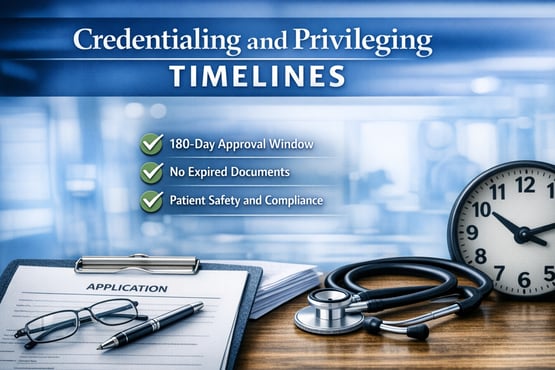
Most organizations establish a 180-day window for completing the appointment or reappointment process. This window represents the maximum allowable timeframe between a provider’s application and formal governing body approval.
This is not a grace period. It is a control.
Applications that are older than 180 days no longer reflect a current attestation by the provider, nor do they reliably support a governing body decision. When facilities approve privileges based on stale applications, they undermine the very purpose of credentialing.
For both initial appointment and reappointment, applications must be dated and signed within 180 days of governing body approval of privileges.
This requirement is frequently misunderstood or inconsistently applied.
An application is the provider’s formal attestation to licensure status, training, competency, health status, and professional history. When that attestation is outdated at the time of approval, the governing body is no longer acting on current information.
Common failure points include:
In each of these scenarios, the issue is not paperwork. It is governance.
Another frequent misconception is that expired documents can be addressed after approval or corrected retroactively.
They cannot.
At the time of governing body approval, all required credentialing documents must be current and unexpired. This includes licensure, board certification when applicable, DEA registration, ACLS or BLS, malpractice insurance, and any other documents required by policy or bylaws.
Approval of privileges when required documents are expired creates immediate compliance exposure.
Equally important, documents cannot be allowed to expire after approval without active monitoring and timely renewal. Credentialing is not a point-in-time event. It is an ongoing condition of appointment and privileging.
Facilities that do not actively track expirables place themselves at risk even when the initial approval was technically compliant.
Treating credentialing and privileging as a checkbox minimizes the real exposure created when timelines are not followed.
The risks are not theoretical.
CMS expects that only properly appointed and privileged providers deliver care. If a surveyor determines that a provider was practicing without governing body approval, this can rise to a Condition-level finding, particularly if the issue is systemic.
Accrediting organizations routinely cite facilities for expired temporary privileges, missing governing body approvals, or incomplete credentialing files. These findings often escalate when leadership cannot demonstrate active oversight of timelines.
Credentialing is not only about licensure. It confirms current competence, scope alignment, and the absence of exclusions or sanctions. Allowing care to proceed without completed verification increases the risk of unrecognized issues that directly impact patient safety.
In the event of an adverse outcome, incomplete or late credentialing files are discoverable. An organization that cannot demonstrate timely approval and verification is placed in a defensive position that is difficult to justify.
Surveyors do not evaluate intent. They evaluate evidence.
An application that is outside the 180-day window or supported by expired documents is not compliant because it can be explained. It is noncompliant because the governing body approved privileges without current, verified information.
Once approval has occurred, the risk already exists. There is no retroactive correction that eliminates that exposure.
Facilities that rely on post-approval cleanup often discover this too late.
Organizations that consistently perform well during surveys treat credentialing and privileging as a timebound governance process, not an administrative task.
Defensible programs demonstrate:
This approach supports regulatory compliance, protects patients, and reinforces the governing body’s accountability.
Credentialing and privileging timelines exist because the governing body is accountable for clinical care delivered within the facility. When timelines are enforced, leadership is actively exercising that responsibility.
When they are treated as flexible, accountability erodes.
This process is not a checkbox. It is a governance control.
Facilities that understand this do not scramble before surveys. They operate in a way that already aligns with regulatory expectations, patient safety, and defensible oversight.
The best governance systems do not create more work. They quietly remove risk from everyday operations.
Learn the four most significant ways that ASCs suffer when contract management remains decentralized.
Understanding the most common red flags can help Administrators, Clinical Managers, Medical Staff Leaders, and credentialing teams identify exposure