

Facilities approve procedures. Practitioners are granted privileges.
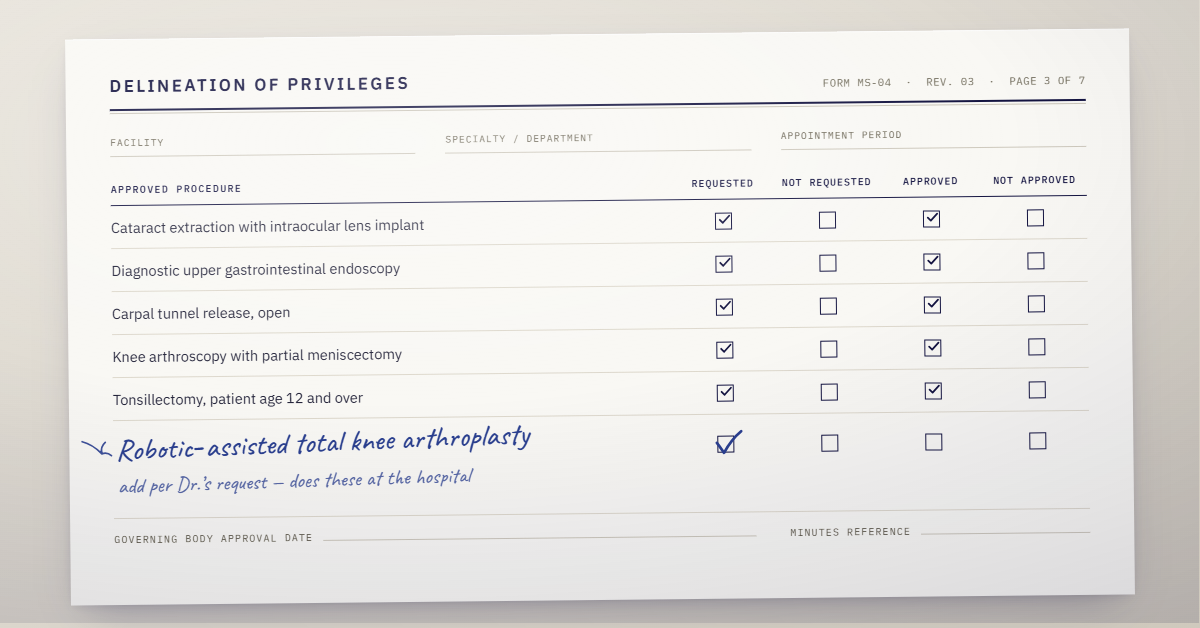
One of the most common governance mistakes in credentialing and privileging occurs when a procedure appears on a Delineation of Privileges (DOP) before the facility has completed the formal approval process required to offer that procedure.
Sometimes the procedure is handwritten onto a DOP. Other times it is typed into an electronic privilege request form, added during review, or included because a practitioner performs it elsewhere. Regardless of how it appears, the underlying problem is the same.
The facility begins evaluating a practitioner's eligibility for a procedure before determining whether the procedure itself has been approved for the facility.
A new procedure should never enter the privileging process simply because a practitioner requests it. Before any practitioner can request or be granted a privilege, the organization must first determine whether the procedure belongs within the facility at all.
The DOP is not a tool for creating new procedures. It is the document that records privileges the facility has already approved, defined, and established through its governance process.
The Procedure Must Be Approved Before It Can Be Privileged
A common mistake is focusing immediately on the practitioner.
- Does the surgeon have the necessary training?
- Have they performed the procedure elsewhere?
- Do they have sufficient case volume?
- Can they demonstrate competency?
- Employee competency and education
- Equipment and instrumentation
- Anesthesia support
- Recovery capabilities
- Sterile processing considerations
- Transfer agreements
- Facility resources and infrastructure
- Site-of-service restrictions
- Coverage policies
- Contracted reimbursement
- Prior authorization requirements
- Implant and supply costs
- Financial viability
- The practitioner is a new applicant.
- The practitioner is being reappointed.
- The practitioner has eighteen months remaining in an existing appointment period.
Those are important questions.
They are simply not the first questions.
The first question is:
Has the facility approved this procedure for performance within the organization?
Until that answer is yes, practitioner qualifications are premature.
The organization must first determine whether it can safely, operationally, financially, and legally support the procedure. Only after the procedure has been approved by the organization should it become available for privilege requests.
The Eight-Step Process for Adding a New Procedure
Adding a new procedure is a facility governance process first and a credentialing process second.
Before any practitioner can request the privilege, the facility should complete a structured evaluation process.
1. Written Request
A formal request is submitted identifying the proposed procedure, supporting clinical rationale, anticipated volumes, outcomes data, and supporting evidence.
2. Criteria Review
The organization establishes the qualification criteria necessary to perform the procedure, including training requirements, competency expectations, case volume thresholds, and any future proctoring requirements.
3. Regulatory Review
The procedure is evaluated against CMS requirements, state regulations, facility licensure requirements, and scope-of-practice considerations. A favorable answer from one regulator does not eliminate the need to satisfy all applicable requirements.
4. Capability Assessment
The facility evaluates whether it can safely support the procedure, including:
5. Payer and Financial Review
The organization evaluates:
A procedure that is clinically appropriate may still be financially unsustainable.
6. Medical Staff Recommendation
The proposed procedure is reviewed through the appropriate medical staff processes, resulting in a documented recommendation regarding whether the facility should add the procedure to its approved procedure inventory.
7. Governing Body Approval
The governing body formally reviews and approves the procedure for the facility. The approval is documented in the meeting minutes and becomes part of the facility's governance record.
8. Amend the Facility DOP
Only after approval is complete should the facility update its master DOP and privileging documents.
At this point, the procedure becomes part of the facility's approved procedure inventory and may be made available for practitioner privilege requests.
What Happens Next?
Only after the facility has completed the approval process should a practitioner request the privilege.
At that point, the facility can evaluate whether the practitioner meets the established criteria for the procedure, review qualifications and competency, obtain the appropriate recommendations, and move through its normal privileging process.
The facility approval decision and the practitioner privileging decision are related, but they are not the same decision.
This Applies During an Active Appointment Period Too
Another common misconception is that a practitioner who already holds privileges can simply add a procedure during an active appointment period.
They cannot.
The same governance process applies whether:
If the procedure has not been approved for the facility, the organization must first complete the entire facility approval pathway. Only then can the practitioner request the privilege and enter the credentialing and privileging process for that procedure.
There is no governance shortcut simply because the practitioner already practices in the facility.
Why Write-Ins Create Risk
A handwritten addition on a paper DOP and a typed addition on an electronic privilege form create the same problem.
Neither demonstrates that the facility completed the necessary evaluation process.
-
Where is the regulatory review?
-
Where is the capability assessment?
-
Where is the payer analysis?
-
Where is the medical staff recommendation?
-
Where is the governing body approval?
-
Where is the amended facility DOP?
If those elements do not exist, then there is no evidence the procedure was properly evaluated before being introduced into the facility.
A write-in does not document governance.
It bypasses governance.
Governance Before Privileges
One of the most important principles in credentialing and privileging is understanding the distinction between procedures and privileges.
Facilities approve procedures. Practitioners are granted privileges.
A procedure should be evaluated, approved, operationalized, and incorporated into the facility's approved DOP before it is ever presented to a practitioner as an available privilege.
The DOP is not where new procedures are created.
It is where previously approved procedures are assigned to qualified practitioners.
Because every privilege granted is more than a credentialing decision. It is a promise that the organization has evaluated not only the practitioner's qualifications, but also the facility's ability to safely, effectively, and responsibly support the care being provided.